
Subscribe
If Jana Nayagan set out to bid farewell to Vijay the actor, it ends up introducing Vijay the politician every five minutes instead. Somewhere beneath the layers of campaign messaging, symbolism, speeches, slow-motion entries, explosions, and references to Tamilaga Vettri Kazhagam (TVK), there is supposedly a film. Finding it, however, becomes a challenge.
Conceived as Vijay’s swansong before entering electoral politics, Jana Nayagan arrives in theatres after reality has overtaken fiction. Vijay is already Chief Minister, rendering the film’s political messaging strangely outdated. Instead of feeling prophetic, it resembles a campaign video released several months too late.
A remake of Balakrishna’s Bhagavanth Kesari, director H Vinoth borrows the broad outline but stuffs it with enough political symbolism to make the original almost unrecognisable.
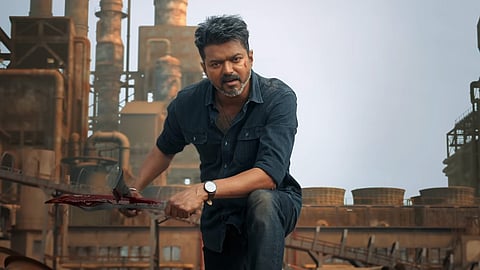
Vijay plays Thalapathy Vetri Kondan—yes, the initials are no coincidence. Vetri is a prison inmate who becomes guardian to Viji (Mamita Baiju), a traumatised young girl who witnessed her mother’s murder and now lives in constant fear. Her personal trauma is repeatedly compared with the “fear” supposedly gripping the people of Tamil Nadu. It sounds profound on paper. On screen, it lands with all the elegance of a PowerPoint presentation on electoral strategy.
The first half races from one scene to another as if it is terrified that audiences might accidentally develop an emotional connection with the characters. Relationships are announced rather than built. Emotional connections are skipped over. Even the decision to avoid a conventional romance—a refreshing choice in theory—doesn’t help because the father-daughter dynamic remains frustratingly underwritten.
Then comes the villain.
Not content with local politics, Jana Nayagan introduces a terrorist named Himmler who has wrecked the fictional country of Swasnia in Africa by instigating a civil war. His next destination is India. The Hitler-coded dictatorship-loving character seems to be modeled around his namesake, the Nazi leader Heinrich Himmler.
And naturally, he already has a mysterious connection with Vijay.
If you’re wondering how a traumatised girl in Madurai, an African warlord, terrorism, electoral politics, the Army, communal harmony, and Vijay’s political future all fit together, the film has the same question.
The second half abandons whatever little coherence the first half possessed. Plot twists arrive one after another, not because they make sense but because someone in the writers’ room apparently believed confusion equals complexity. The revelation surrounding Himmler is unintentionally hilarious, and while numerous subplots wander in, some quietly disappear without resolution.
An honest police man suddenly becomes an aide to terrorists. Why? The film shrugs.
Characters possess classified information simply because the screenplay needs them to. Pooja Hegde plays a journalist whose primary qualification seems to be unrestricted access to confidential files. She spends most of the film looking like she wandered into the wrong script.
The flashback of Vetri’s life as a police officer and the ‘Naveena Kannagi’ episode aren’t storytelling as much as campaign speeches disguised as cinema. References to the Kallakurichi hooch tragedy, the Sterlite police firing, women’s empowerment, and veiled attacks on dynasty politics arrive in rapid succession, not because the narrative demands them, but because the film has a checklist to complete.
The crowning moment comes when an AI-generated MGR symbolically hands Vetri a whip to punish a corrupt politician, an unsubtle attempt to anoint Vijay as MGR’s political heir. Instead of evoking goosebumps, the scene is so heavy-handed that it only elicits a chuckle.
At several points, actual TVK functionaries make cameo appearances, and Vijay delivers dialogues that sound less like conversations and more like election speeches. Several dialogues are also muted, which ruin the experience of watching the film.
Mamita Baiju emerges as one of the few bright spots, bringing sincerity to a role that deserved a far better film. Bobby Deol certainly looks intimidating as Himmler until the screenplay patiently dismantles every ounce of menace his character initially possesses.
By the end, Jana Nayagan becomes less a film than a deafening exercise in self-mythologising. Every scene insists on reminding viewers that Vijay is courageous, compassionate, incorruptible, beloved by women, adored by children, respected by soldiers, feared by terrorists and, just in case anyone missed it, ready to lead Tamil Nadu.
The result is an exhausting cacophony of speeches, symbolism, action sequences, and political messaging stitched together into something that resembles cinema only intermittently.
As a farewell to one of Tamil cinema’s biggest stars, Jana Nayagan should have celebrated the actor audiences fell in love with. Instead, it spends nearly three hours campaigning for the politician.
In its desperate bid to crown Vijay the politician, Jana Nayagan forgets to give Vijay the actor the farewell he deserved.
Disclaimer: This review was not paid for or commissioned by anyone associated with the film. Neither TNM nor any of its reviewers have any sort of business relationship with the film’s producers or any other members of its cast and crew.
