
Subscribe
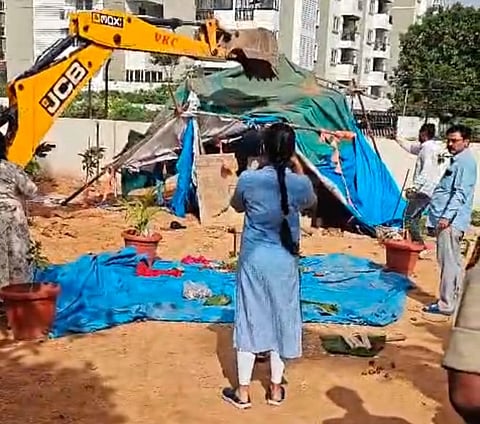
The Bangalore Development Authority (BDA) has demolished a temple that was illegally built almost overnight by a section of residents on the premises of an apartment block constructed by them.
However, residents of several private apartments in the city which have seen similar developments allege inaction from civic authorities despite repeated complaints and court orders.
The BDA officials demolished a temple built without approval at Skandagiri BDA Apartment Phase-2 in Konadasapura, Whitefield, on Monday, July 13. The BDA had issued a third notice on July 6, asking the residents to voluntarily demolish the temple. When there was no response, the BDA stepped in along with the police and demolished the temple, which was a site marked for the common recreational use and civic purposes.
Residents who spoke to TNM said that the issue began in January this year, when a group of residents set up a makeshift platform to hold a Saraswati pooje (worship of goddess Saraswati) on January 23, in the northwest corner of the premises.
“But they didn’t remove the pandal after that. Almost overnight, they replaced it with an idol of Anjaneya and turned it into a temple,” said Chandrakanth, a resident of the apartment.
On January 28, a resident posted a message on a WhatsApp group comprising both BDA officials and apartment owners, stating that efforts were on to build a Hanuman temple and seeking donations. “We lovingly invite you to be a part of this noble cause by offering your generous donation for Lord Hanuman. Every contribution, big or small, is a sacred offering that will help lay the foundation of this holy temple and earn divine blessings for you and your family,” the message said.
Several residents objected to this announcement on the group, questioning why it was being done and whether it had been discussed.
A separate WhatsApp group was then set up to coordinate pooje activities, rituals and funds for the Hanuman temple, another resident, Kiran R said.
Even polls were held on WhatsApp asking questions like ‘Are you ok with increasing park encroachment and daily use of loudspeakers in the society?’
Many people objected to the continued use of loudspeakers while those backing the temple took offence at the temple being called an encroachment.
Another resident said, “... the small Lord Hanuman temple should not be referred to as encroachment as it is not increasing (sic)—sharing this only to avoid misunderstandings and maintain harmony among residents.”
Through March, construction went on, and the makeshift structure took on a more concrete form.
Meanwhile, the row over the temple turned ugly. “Some of the temple’s backers went from house to house, abusing people. They labelled those who objected to the illegal construction as ‘anti-national’ and ‘anti-Hindu’. It went to extreme levels,” Kiran alleged, adding that he and others had to file complaints with the Avalahalli police who registered a Non-Cognisable Report (NCR).
According to both Kiran and Chandrakanth, the issue was not just along the lines of support or opposition to the temple. The conflict had an undercurrent of regional antagonism as well.
“More than a hundred of the apartment’s 672 flats have been bought by people from Odisha. A group of these residents were pushing for the temple,” Chandrakanth told TNM.
Kiran said that the situation would not have reached such extreme levels had there been an official apartment association. He said that the sub-registrar had thrice rejected their attempts to form an association under the Apartment Owners Act 1972 as the residents could not obtain the signatures of all the residents as the law required. “About 200 of the apartments are purchased but vacant, and it’s impossible to contact the owners,” Kiran said.
He added that residents had sought legal redress in the Karnataka High Court.
TNM has reached out to people who were supporting the temple, but one of them declined to speak for this story. He said that he would connect TNM with a person willing to speak. This story will be updated if TNM receives a response.
On being questioned about the demolition of the temple, the BDA responded on X, saying that it had merely removed an unauthorised structure after following due process.
“... it is informed that the temple in question had been constructed unauthorisedly within the designated park area. As the land is reserved for public park purposes, BDA is obligated to enforce the applicable planning regulations and statutory provisions. Accordingly, the unauthorized structure was removed as part of the enforcement process. The action was carried out in accordance with the prescribed norms and was not directed against any particular place of worship or community,” BDA said in a post on X on July 17.
The BDA itself has since offered to build a temple if all the residents were in favour of it, Chandrakanth said.
Other apartments facing similar issues
A resident of Brigade Seven in Uttarahalli in southwestern Bengaluru alleged that his apartment complex faces a similar issue that is yet to be settled.
A resident named Shankar (name changed on request), alleged that around a year ago, the apartment association itself built a temple in a common area without the necessary approvals from the authorities. “No temple was marked out in the approval plans. And when we ask questions, there are no answers,” he told TNM.

The plan to install an idol was first mooted in December 2024, during the general body meeting. A non-Hindu woman objected to the construction in the common area and asked if similar demands from people of other religions would be entertained, Shankar said.
“It turned into a big fight. While that was going on, the voice vote was held and they got a yes. Another woman who opposed it was targeted personally just because she spoke up. It almost turned physical. It was that intense.”
The association went ahead and built a makeshift platform, and by mid-June 2025, the temple had its current structure. “It’s a full scale temple now. There are prasada distribution events every week. People are even donating silver jewellery for it.”
Shankar said that he was not opposed to religious celebrations that were limited to day-long festivals. The apartment celebrated Christmas too.
“Celebration is not a problem when it’s just for a day. But when you use the common area for a temple, you are stepping on someone else’s property rights. That property belongs to all the residents. You need consent, and you need permission. I can’t even build a wall in my own apartment without approvals, how can they build a temple in the common area? They’re stepping on someone’s rights.”
He also said the BDA could fine the apartment lakhs of rupees for unauthorised construction. “Tomorrow if something happens, and the BDA fines us lakhs of rupees, the association will be liable. The money will have to come from the common pool of money and the temple was not built with everyone’s consent.”
An office bearer of the association that TNM reached out to responded to the allegation that the temple was unauthorised, but said that the information could not be used and also declined to be identified.