
Subscribe
There is something revealing about a protest that is stopped before it even begins. The state is spared the inconvenience of a gathering, the spectacle of a crowd and the possibility that a political demand might acquire a life of its own. What remains is an administrative account of order maintained.
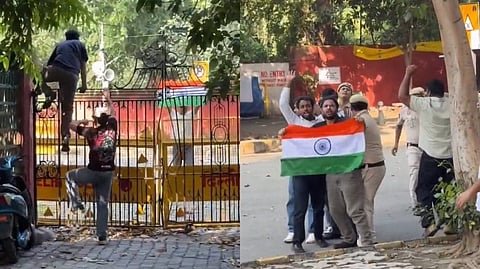
On October 10, 2026, Cockroach Janata Party (CJP) founder Abhijeet Dipke and fellow leaders Saurav Das and Ashutosh Ranka were detained inside their aircraft upon arriving in Delhi. YouTuber Dhruv Rathee was also detained from his Gurugram residence. These actions came ahead of a planned demonstration at Jantar Mantar against alleged irregularities in the Special Intensive Revision (SIR) of electoral rolls and demanding the resignation of Chief Election Commissioner Gyanesh Kumar.
The mobilisation brought together constituencies that refuse to be ideologically collapsed into one another. CJP, student activists associated with the All India Students’ Association (AISA), lawyers and political leaders have different demands and political commitments. What unites them is the question of whether institutional accountability can be publicly demanded without those seeking answers facing the consequences of preventive action.
The subsequent decision to remove Jantar Mantar from the list of designated protest sites makes this question more pressing. On October 11, the Delhi Police issued an order de-notifying the site and designating Ramlila Ground, Burari Ground and CBD Ground in East Delhi as alternatives, following recommendations from a committee constituted by the Union Home Ministry. Detailed operating procedures for the new venues are to be issued separately.
The logic of prevention
The mounting frustration must also be understood against the wider crisis of institutional dialogue in today's India. Opposition leaders have demanded answers from the Election Commission over the electoral-roll revision. During the protests, MPs, including Leader of the Opposition Rahul Gandhi and Priyanka Gandhi Vadra, were reportedly removed and detained by police.
Preventive measures allow the state to act in anticipation of an event whose precise character remains uncertain. An intervention ensures that the event never occurs. Its absence may subsequently be offered as evidence that the intervention was justified. But the impossibility of proving what might have happened cannot become a substitute for evidence of a credible threat.
The Supreme Court in Mazdoor Kisan Shakti Sangathan v. Union of India (2018), considered the relationship between peaceful protest, public spaces and competing rights. It held that while demonstrations may be regulated to protect legitimate public interests, it does not mean that the right to assemble can be extinguished simply because its exercise creates administrative difficulty. The court specifically recognised that the constitutional task is to reconcile competing interests, not presume that public order and political freedom are necessarily antagonistic.
The de-notification of Jantar Mantar brings this tension into sharper focus. While the state may designate alternative venues, the existence of alternatives does not, by itself, establish that the right to protest has been adequately protected. Their accessibility, capacity, location, conditions of use and permission procedures all matter. If the new arrangements make demonstrations materially harder to organise or less capable of reaching the institutions and public they seek to address, then such a relocation risks becoming an underhanded restriction.
The timing of the decision is therefore significant for this very reason. The order followed days of detentions and restrictions surrounding a mobilisation whose central demand concerns electoral accountability. The authorities may invoke the need to prevent disruption, and that concern cannot simply be dismissed. However, the larger constitutional question to this cannot be answered by invoking public order alone. The state must take into account that the more consequential the public grievance, the greater the need for restrictions to be justified through reasons that are specific, proportionate and open to scrutiny.
Closing down public and digital space
The nature of restrictions raised further concerns since it extended beyond the physical presence of the protesters. The state went one step further to restrict mobile internet services for 24 hours, which were suspended within a four-kilometre radius of the Janpath Kartavya Path crossing, from 10 pm on October 9 to 10 pm on October 10. Under such circumstances, the shutdown raises questions about the legal safeguards governing restrictions on communications and the practical consequences of disconnecting an area during a politically significant event.
The question is therefore not whether the shutdown automatically violated the Telecommunications Act, 2023, but whether the order complied with statutory requirements and constitutional standards, since a restriction on mobile internet can particularly impinge on the freedom of speech and expression guaranteed under Article 19(1)(a), the freedom to practise a trade or profession under Article 19(1)(g), and, depending on its effects, other consequent protected interests. Its legality turns on its authority, justification, scope, duration and compliance with procedural safeguards.
It is for this reason that the Supreme Court in Anuradha Bhasin v. Union of India (2020), recognised that freedom of speech and expression through the internet is constitutionally protected and that restrictions must satisfy proportionality. It also held that suspension orders must be published so that affected persons can challenge them. The fact that the Delhi shutdown was limited in duration and geography does not, by itself, establish that it was unconstitutional. But neither does a security rationale settle the question. Statutory conditions and constitutional safeguards are substantive requirements, not formalities that can be satisfied merely by invoking public safety.
An internet shutdown specifically will have a menacing effect since it affects people who have nothing to do with a demonstration; residents, workers, journalists, small businesses and those relying on digital payments or online access to essential services. More fundamentally, it can make it harder to document police conduct, verify information and communicate what is happening on the ground. The constitutional concern thus is not confined to whether protesters can assemble. It extends to whether citizens retain the practical ability to speak, observe and be heard while the state manages a public gathering.
The Supreme Court’s intervention concerning Metro and railway restrictions offers a parallel illustration. On October 9, in MA Baby v. Union of India, the court questioned restrictions that could prevent ordinary transport services from operating, describing the proposed curbs as potentially excessive. It recorded assurances that services would be regulated rather than subjected to an outright prohibition, called for public advisories and asked authorities to consider suitable alternative protest sites with basic amenities.
The court’s response here recognised that preventive restrictions affect not only demonstrators but also commuters and residents with no connection to the protest. A measure intended to preserve order can itself cause substantial mischief in the form of public disruption. A subsequent contempt petition filed before the Supreme Court alleged that some Metro stations in Delhi remained closed despite the court’s directions. This is particularly worrying because it illustrates a further difficulty which is that constitutional remedies depend not only on judicial recognition of rights but also on effective compliance with the orders that protect them.
As a debilitating effect, the restrictions have continued to severely affect movement to and within the capital. On October 12, amid renewed Opposition demonstrations, entry and exit at six Metro stations were again closed for specified hours for security reasons. Such measures may be justified in particular circumstances, but their necessity and proportionality must be assessed in context, especially when they accompany restrictions on assembly and communication.
Taken together, restrictions on transport, mobile internet and physical access to protest sites raise a question of cumulative impact. Each measure may be defended as a discrete precaution. But when they operate simultaneously, their combined effect on assembly, communication and public scrutiny deserves examination. Constitutional proportionality requires attention not only to individual restrictions but also to the burden they collectively place on the exercise of fundamental rights.
The constitutional cost of silence
Articles 19(1)(a) and 19(1)(b) of the Constitution protect expression and peaceful assembly, while Article 21 safeguards personal liberty. Separately, the Bharatiya Nagarik Suraksha Sanhita, 2023, permits preventive intervention in defined circumstances. But the existence of statutory authority does not settle the question of whether its exercise is necessary, proportionate or consistent with fundamental rights. Denying permission for a demonstration and detaining its organisers are legally distinct acts. The former cannot, by itself, justify the latter.
It is during times like these that one is reminded of Umar Khalid’s incarceration in the separate Delhi riots conspiracy case, which belongs to a different legal category from the detention of protest organisers. While his case should not be conflated with these incidents, it nevertheless forms part of a longer debate about prolonged pre-trial incarceration and the consequences that can accompany political mobilisation. The broader question remains how constitutional systems should guard against the possibility of the legal process becoming a substantial burden on liberty.
The danger is therefore not simply that preventive detention powers may be exercised unlawfully, rather it is that their repeated use may normalise a political order in which dissent is treated as a problem to be managed before its substance is heard.
The language of an undeclared Emergency therefore becomes difficult to avoid when preventive powers are exercised at such scale that democratic participation is severely curtailed before it can even take shape. The reported detention of thousands of people ahead of a planned demonstration raises a question that extends beyond the legality of any individual arrest: what happens to democratic participation when the state treats the possibility of collective dissent as a threat to be neutralised?
This is not to equate the present circumstances with the Emergency formally proclaimed in 1975. It is, rather, to recognise that constitutional freedoms can be eroded through the cumulative exercise of ordinary powers, without the formal suspension of fundamental rights. The warning of ADM Jabalpur v. Shivkant Shukla (1976), in which the Supreme Court majority denied the availability of habeas corpus to challenge detention during the Emergency, remains instructive precisely because of the institutional failure it represents.
The decision was subsequently repudiated, most explicitly in the constitutional reasoning of KS Puttaswamy v. Union of India (2017). Its enduring lesson is that personal liberty cannot be made contingent on the state’s assessment of what public order requires. The question today is not whether the legal conditions of 1975 have returned, but whether preventive action, when deployed on a mass scale, risks producing a democratic condition in which citizens retain their formal rights while losing the practical ability to exercise them.
The normalisation of constitutional exceptionalism
Historian Anne Applebaum’s work on democratic erosion offers a warning when studied in this context. The theory asserts that authoritarianism can also develop under elected governments as independent institutions are weakened and public faith in accountability is eroded. She further argues that when citizens are made to believe that institutions cannot be questioned, that facts are merely partisan and that political participation cannot produce change, democracy risks descending into nihilism.
This is the danger of overreach in a protest centred on electoral rights in a democracy. If demands for electoral accountability are met primarily through detention and restrictions on assembly and communication, the state risks deepening the very institutional distrust that brought people onto the streets.
This is precisely why the removal of Jantar Mantar as a designated protest site makes the warning concrete. A democracy cannot preserve public confidence in its institutions simply by denying citizens access to protest sites or directing them elsewhere when they seek to deliberate them. A constitutional democracy must preserve the capacity to regulate public gatherings while recognising that protest is one of the means through which citizens hold institutions accountable. This does not require the state to accept every allegation, grant every meeting or ignore credible security risks. It requires the state to justify restrictions with reasons that can withstand legal scrutiny, and to ensure that preventive measures are no broader than necessary.
In other words, the test is not whether the state can preserve order; every state claims that capacity. It is whether order remains the condition in which political freedom can be exercised, rather than the justification through which that freedom is progressively confined. So when the state intervenes before a protest even begins, the question is not only what it has prevented. It is also what has made it impossible, and whether the Constitution permits that loss to be treated as an ordinary incident of keeping the peace.
Sithara Sarangan is an advocate and public law researcher. Views expressed are the author’s own.
Follow TNM's WhatsApp channel for news updates and story links.
