
Subscribe
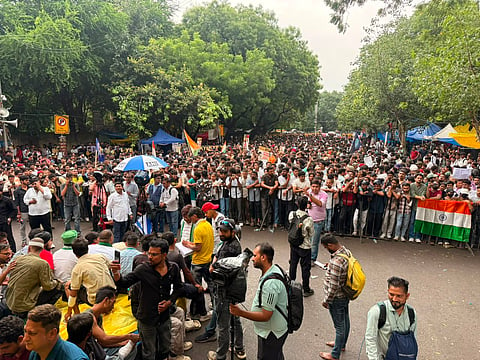
It would be a great mistake to attribute the success of the recent youth-led protests at Jantar Mantar and elsewhere in India to something innate about the attitudes of an entire generation marked by an alphabet. The tendency to characterise the attitudes of the ‘visible youth’ as a marker of an entire generation is homogenisation and stereotyping at its purest. As a teacher who speaks with students coming from different backgrounds, I find it very obvious that students live in very distinct worlds. Sometimes their worlds intersect with each other and sometimes not.
Some are bothered by the attacks on students at Columbia University, and some are excited about the release of a recent movie by Dhanush. The ones who are politically articulate are not necessarily the most politically aware. Articulation alone never translates to investment in political change. The articulate become the ‘visible youth’. They tend to be characterised as the voice of an entire generation.
When such a voice stands against fascism and uses a politically correct language of inclusivity, it is tempting to consider it a moment of change. For decades, the Bharatiya Janata Party (BJP) had managed to distract the youth and prevent them from becoming a political force. The progressive movements always lamented the apathy of the youth. Now, when we see the youth taking to the streets and turning the propaganda of the BJP upside down with their irreverence towards authority, it is difficult not to celebrate it. In fact, it ought to be celebrated.
The way in which the protesters were making fun of the political class and the police is absolutely hilarious. This protest has brought comic energy to the streets and turned that energy into a weapon against political power. If comedy clubs are vandalised, then the street shall be turned into one. It’s not just comedy employed to protest, it is protest itself becoming comedy. If one just casually navigates social media, one cannot stop laughing at the hilarious memes and reels made out of all the antics performed by the protesters.
Watching this protest unfold on social media felt like watching the French movie ‘Athena’ made by Romain Gavras, in which youth engage in a battle with the police after watching a video in which the police are seen to be beating and killing a small kid, but the only difference is that the protesters engaged in battle with the police at Jantar Mantar were also comic artists. This is what the success of the protest should teach us: how comic energy can subvert power, how irreverence can be an expression of political disagreement, how a protest can become comedy and how such a comedy can become an actual protest.
However, what we saw on social media may not necessarily represent the entire youth. The reason for saying this is very simple. The project of the Indian nation to create one community with a singular identity never even took off. What we had instead, after independence, was the mechanism of power transfer which created the hope that those who had suffered injustice now had the opportunity to attain power and undo the root causes of the injustice. Such a hope has propelled the project of building a nation and establishing a democratic society and continues to inspire thousands of people, including many youth, into believing that a true democracy is possible if only political power is attained.
This is a myth. The mechanism of power transfer doesn’t need democracy as its foundational principle. It works even without democracy. It works if a group manages to show strength and its ability to employ violence. The reason why the government negotiated with the Jantar Mantar protesters is that the protest could get out of hand and eventually turn into violence. Any protest on the street which manages to disrupt everyday life in any form is successful because there is a latent threat of violence in it. This should not be mistaken as characterising the protests as violent in the same way the government was trying to portray them. The protest in itself was not violent, but it had the potential to threaten the state’s monopoly over violence.
David Graeber, the anthropologist-anarchist, drawing from Max Weber, points out in his essay ‘Dead Zones of the Imagination’ how it is the state which always has a monopoly over legitimate violence. It is the only legal entity which can employ violence over people. It is this threat of violence that the state uses to ensure citizens follow the law and behave in the manner it determines. The contract between people and the state is never built on equal grounds.
It is similar to how a conquering power controls a vanquished community through the direct threat of violence. The victor, out of his benevolence, allows the vanquished to live, and hence they owe the victor their life. It replicates the relationship between the coloniser and the colonised. The state is the benevolent conqueror which has allowed its citizens to live as per the terms and conditions set by it. The government and the protesters don’t stand on the same ground, and hence there is no parity between them. The Indian state is no exception to this. These protests are not happening inside a democracy; they are attempts at establishing one.
Once we recognise that we are not really living inside a democracy, it is easy to see why there is not simply one category of youth in our society. Ours is a society in which people live next to each other but can belong to starkly contrasting social worlds. Some think they live in a democratic world simply because they have access to resources which grant them the privilege of living in a free and democratic world. An urban youth with a privileged background walking into a police station and getting justice is not an indication of democracy working. It is access working.
In the same way, a rural Dalit youth who knocks at the gates of a police station seeking justice and is beaten for it is not encountering a simple lack of democracy. It is deep-rooted caste inequality expressing itself. Both these youths do not live in the same world. Even when both of them hit the streets in protest and join hands, their worlds are still distinct. It is only when privileges are removed that people come to terms with the fact that they are not living inside a democracy.
Yet, as David Graeber points out, any society constituted through the threat of violence produces what he calls ‘lopsided structures of the imagination’, in which the ones living under the threat of violence continuously do ‘interpretive labour’ in order to figure out what the ones in power want from them. Most disenfranchised Indians are currently doing this invisible interpretive labour just so they can stay alive and lead a life. Whatever world a person inhabits, once they stand inside a crowd, something else besides class or privilege begins to act on them.
Most people live, communicate and shape their lives within a limited sphere. Their worldviews are still decisively shaped by their immediate physical surroundings. Although the internet and social media are slowly replacing the physical with the virtual, the physical world still continues to determine how we think and behave. The protest gatherings themselves are an excellent example of this. The electrifying atmosphere is highly contagious. When people see others feeling free and expressing themselves without inhibition, there is a natural impulse to allow ourselves to behave that way. This is true of street protests and cricket stadiums alike.
The youth, by participating in something common for the first time, realised the power of physical proximity over their thinking and behaviour. This is not a new insight. This is what we see in every mass movement. It is people coming together on the streets and acting in unison which constitutes power and which ultimately threatens the state’s monopoly over violence. The digital natives discovered it for the first time, and they enjoyed it tremendously. This discovery belongs to the crowd, not to a generation.
Attitudes are driven by the medium within which we articulate and communicate. Social media has pretty much monopolised our medium of communication and the site of any conversation. There is an interesting battle going on between the state and the big tech companies which control social media. The result of the tug of war between the state and the tech companies over who gets to decide what content appears and disappears, what goes viral and what is hidden, will ultimately determine who gets to be the coloniser. The ability of tech companies to effect behavioural change is unparalleled.
They have the ability to do it but lack the legal permission. It is not enough for them to monopolise our attention and behaviour, or the very space in which we communicate, coordinate and build relationships. They are now set on monopolising the very space in which we reflect. The AI chatbots are slowly taking over the most inaccessible space for any tech so far: our inner lives, our inner conversation, our ability to reflect, quarrel with oneself, experience solitude. This is total colonisation. The AI models are calibrated by humans who make decisions.
Once our dependency on them is complete, so is the colonisation of our inner self. Denial of access to the AI models would be the new threat of violence, replacing the bullet, tear gas and lathi. It is ironic that the protest to establish a democracy would unfold in a space created by an entity whose motives are far more sinister than the state’s own.
Whoever wins this battle will also decide which youth are seen and which are not. A generation gets its name in that space. If Gen Z is a term that denotes youth born after a certain year, then it is meaningless. If it denotes an attitude, then it cannot be generational. The trend of naming and characterising an entire generation will not help us in understanding what we saw at Jantar Mantar and other places.
What we need is a much older kind of critique that understands Indian society as one that was constituted politically in a moment in the past. It carried within itself the existing fragmentation, hierarchy and injustice. The project of democracy could never become a project of achieving justice. The caste, class and gender hierarchy continued to remain as an essential feature of Indian society. We can see how this has deeply percolated within every aspect of our personal and public life. No institution, whether private or public, religious or secular, is free from caste, class and gender bias.
The youth coming from different backgrounds and living and interacting with such institutions experience the world differently. It allows some to become visible and become part of an articulated protest, while many continue to protest in ways that social media may never be able to capture. One just needs to recollect Jabya throwing a stone at the camera in Nagaraj Manjule’s film Fandry, a reminder that there are languages of protest that don’t render themselves easily to social media articulation. Which languages of protest survive, then, is not just a matter of who is watching but of who owns the space in which the watching happens. Can the category of Gen Z ever accommodate someone like Jabya?
Vinay Kambipura is Asst. Professor, Department of English, St Joseph’s College of Commerce (Autonomous), Bengaluru. Views expressed are the author’s own.
