
Subscribe
Follow TNM's WhatsApp channel for news updates and story links.
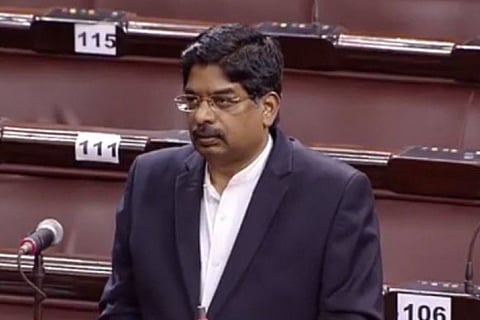
The Union government’s latest defence of its Ethanol Blended Petrol (EBP) programme in Parliament has drawn criticism from Dravida Munnetra Kazhagam (DMK) Rajya Sabha MP and senior advocate P Wilson, who questioned the lack of an assessment of E20 petrol’s long-term impact on consumers and flagged what he called a “glaring regional imbalance” in ethanol production infrastructure.
Responding to Wilson’s questions in the Rajya Sabha on August 3, Minister of State for Petroleum and Natural Gas Suresh Gopi said India has achieved nationwide 20% ethanol blending since December 2025, has 478 ethanol manufacturing units, and has approved Rs 4,687 crore in interest subvention for ethanol projects. The government also reiterated that while E20 may reduce fuel economy by around 3-5% in certain vehicles, studies have found no widespread adverse impact on vehicle performance.
Wilson had asked the Union government for details on India’s ethanol production capacity, financial incentives provided to the sector, the impact of E20 petrol on vehicle performance and consumer expenditure, and the challenges in implementing the programme.
While welcoming ethanol blending as a step towards reducing crude oil imports and promoting cleaner fuel, Wilson argued that the government’s response did not answer what he described as the most important questions.
“The Ministry’s reply leaves several important questions unanswered,” Wilson said in a post on X. “It has not disclosed any independent assessment of the long-term impact of E20 on consumers’ fuel expenditure, particularly for owners of older vehicles. Nor has it explained how motorists are expected to absorb even a marginal reduction in mileage when fuel prices continue to remain high.”
Wilson also questioned what he described as the uneven distribution of ethanol infrastructure across the country.
According to data shared by the Ministry, Maharashtra has 145 ethanol manufacturing units with an annual production capacity of 389 crore litres, Uttar Pradesh has 79 units producing 344 crore litres, and Karnataka has 50 units with a capacity of 321 crore litres.
In comparison, Tamil Nadu has just 16 ethanol manufacturing units with an annual production capacity of 34 crore litres.
“If the Ethanol Blended Petrol Programme is to become truly national, the benefits of investment, production capacity and infrastructure must be distributed equitably across all States. Tamil Nadu cannot be left behind in India's biofuel transition,” Wilson said.
What the government said
In the written response to Wilson's questions, the Ministry said India now has 478 ethanol manufacturing units with a combined annual production capacity of 2,019 crore litres, and that public sector oil marketing companies have been supplying 20% ethanol-blended petrol (E20) across the country since December 2025.
It also said the Union government has approved Rs 4,687 crore under various interest subvention schemes to encourage companies to set up new distilleries and expand existing ones. Other measures include reducing GST on ethanol supplied under the EBP programme to 5%, expanding the range of raw materials that can be used to produce ethanol, and introducing assured procurement by oil marketing companies.
On vehicle performance, the Ministry said studies conducted by government agencies, automobile manufacturers, and oil companies found no widespread adverse impact from E20 fuel.
However, it acknowledged that fuel economy in some vehicles originally designed for E10 petrol may fall by around 3-5%, while stressing that mileage depends on several other factors, including driving habits, tyre pressure, vehicle maintenance, and air-conditioner usage.
The Ministry also said more than 20 crore two-wheelers and over three crore petrol cars have been running on higher ethanol blends for more than two years without any verified evidence of widespread engine failure or abnormal wear.
The Ethanol Blended Petrol Programme is one of the Union government’s flagship initiatives to reduce India’s dependence on imported crude oil, cut emissions, and create an additional market for agricultural produce.
In its reply, the Ministry said India imports nearly 85% of its crude oil requirement. It argued that blending domestically produced ethanol with petrol has helped reduce dependence on imported fuel and soften the impact of spikes in global crude oil prices.
