
Subscribe
Around 27 kilometres west of Nagercoil in Tamil Nadu, along the coastal road from Midalam towards Enayam and Thengapattinam, the shrinking distance between homes and the Arabian Sea has become a measure of loss.
TNM met Pushpam, a resident of Midalam village, on the steps outside her home, among a small cluster of houses facing the sea. On her hand is a green-ink tattoo bearing the name of her late husband Varghese, a reminder of the life she began here six decades ago, when she arrived in the village as a 14-year-old bride.
When she arrived, her house was among the last rows of homes near the shore. The sea was a 15-minute walk away. Today, the same house stands at the edge of a coastline that has steadily moved towards it.
“Now I am 75. Until a few years back, this house was in the last row from the beach. Now it's the first one and the sea is this close,” said Pushpam, gesturing towards the waves.
Over the years she was witness to houses getting lost one by one. “The sea comes closer every year. Many have moved, but I cannot. Let me die here,” she said.
A few houses away, Dasammal and Yasinthal run a small shop attached to their home. The two women, in their mid 60s, have watched the coastline disappear over the years.
“Many changes were witnessed in the past 20 years. We had this roadside shop, which was quite far from the sea. Now they are close. Only a few old people like us live in this thin stretch,” Dasammal said.
For residents across this coastal belt, from Keezhmidalam, Midalam, Inayam Puthenthurai, and Kollencode to settlements such as Kurumpanai, Melmidalam, Kelan Nagar, Revenue Inayam to Marthandamthurai and Neerodi, the disappearing coastline is a reality they have lived through.
“The shore is already gone to a great extent. Let it happen naturally, but we wouldn’t allow anybody to touch the shore,” said Dasammal.
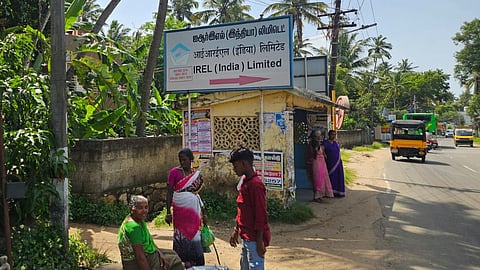
Over the last four years, they have been resisting the plan by the Indian Rare Earths Limited (IREL) to extend the area of mining mineral-rich sand from the belt, unmindful of the coastal erosion and the impact it had on stretches where mineral extraction has already been completed.
The IREL is a public sector enterprise under the Department of Atomic Energy (DAE), engaged in mining and processing mineral sands found along India's coasts.
The Tamilaga Vettri Kazhagam (TVK) government’s recent decision to extend the land reservation (area where mining is permitted) for the project has renewed these concerns. A government order issued on June 10 extended the reservation of the coastal land until June 10, 2027, giving IREL more time to secure the remaining approvals required for the project.
Kanyakumari has a long history of coastline erosion due to human intervention. The region’s 77-km coastline has witnessed major shoreline changes between 1980 and 2020 according to researchers. The changes were driven by natural movements of sediments, man-made structures such as groynes, and activities including mining. A study by S Chrisben Sam and B Gurugnanam of the Centre for Applied Geology, Gandhigram Rural Institute postulates that by 2040, areas like Inayam could lose up to 200 metres of coastline.
The study also warned of threats to livelihoods and local economies while recommending urgent, coordinated coastal protection measures in high-risk areas.
The coastal stretch from Kurumpanai to Neerodi in Kanyakumari is rich in heavy minerals such as monazite, zircon, ilmenite, rutile, sillimanite and garnet.
Under India's current legal framework, mining and handling of monazite-bearing sands and the extraction of rare earth minerals are restricted activities. These operations are permitted only through the IREL.
The proposed project covers 1,144.06 hectares (2,827 acres) across eight revenue villages in Kanyakumari district’s Kiliyoor taluk. According to the IREL, the project is crucial for India's atomic energy programme.
The TVK decision to allow the IREL to extend the mining area has drawn criticism because they had earlier opposed the proposal. In November 2024, the party had passed a resolution demanding its withdrawal, citing environmental concerns.
While the state government permission itself does not allow mining to begin, residents see it as a green signal. The project, classified as a Category A, requires approval from the Union government and is yet to receive approvals including Coastal Regulation Zone (CRZ) clearance.
The fears of residents are shaped by what they have already witnessed in neighbouring Manavalakurichi, where the IREL has operated for decades, and along Kerala’s mineral-rich coast, including Chavara, Alappad and Thottappally, where communities have faced erosion, land loss and displacement linked to decades of mineral sand extraction.
The residents are now preparing for another round of protests against the project, fearing that large-scale extraction could further damage a coast already struggling with erosion and land loss.
According to the Expert Appraisal Committee (EAC), a body constituted by the Ministry of Environment, Forest and Climate Change (MoEFCC), the proposed mining method is unlikely to cause permanent environmental damage and may even reduce existing background radiation levels. Under the proposed Rs 31.25 crore project, beach sand deposits would be excavated up to a depth of around nine metres. The extracted sand would be transported to IREL’s Manavalakurichi processing plant, while mined areas would be progressively backfilled and restored as part of the mine closure plan.
The Manavalakurichi plant has a total production capacity of 1,14,600 tonnes per annum for ilmenite, rutile, zircon and garnet.
The 2025 IREL annual report says the mineral production at Manavalakurichi plant has plateaued due to exhaustion of land allocated for mining in existing leases.
As one travels along the coastal stretch from Thengapattinam to Colachel, beside the Anantha Victoria Marthandam (AVM) Canal, huge heaps of sand can be seen piled near the shore. Residents claim these mounds are leftover material from mineral sand extraction, dumped back along the coast after processing.
The AVM Canal is a historic inland waterway built during the Travancore royals in the 19th century to connect coastal settlements with major trade centres in present-day Kerala and Tamil Nadu. Running parallel to the Arabian Sea through several fishing villages, the canal once served as a vital route for transporting goods, supporting agriculture, irrigation and local travel. Although it has largely lost its transport role with the expansion of road networks, the canal remains an important source of water and a key part of the region's ecological and cultural landscape. According to residents, the pollution faced by AVM Canal is a result of the mining activity in the region.

For residents of Kanyakumari’s coastal villages, the fear of expanded mining comes from what they witnessed around Manavalakurichi. The IREL plant extracts thousands of tonnes of beach sand every day from the coastal areas of Periyavilai and Chinnavilai, which residents allege has disrupted the natural movement of coastal sediments and accelerated erosion.
“Over the past 30 years, nearly 200 metres of coastline has been lost, with several houses gradually being swallowed by the sea. Coastal protection structures built by the government, including seawalls, groynes and small fishing harbours, have also suffered extensive damage and are slowly collapsing,” said Fr Cripin, parish priest of St Bartholomew’s Church, Kodimunai.
Residents say mining has also destroyed coastal sand dunes and sand ridges that acted as natural barriers against seawater intrusion, protected agricultural land and helped recharge groundwater. They allege that the loss of these natural barriers has affected the AVM Canal, nearby farmlands, drinking water sources and irrigation systems.
“Their destruction has contributed to pollution of the AVM Canal and nearby farmlands, contamination of drinking water and irrigation sources, and broader environmental degradation. The AVM Canal, which is a key source of drinking water for coastal communities and irrigation for farmers, has been severely affected by mining operations,” alleges Kurumpanai C Berlin, district secretary of Neithal Makkal Iyakkam which leads protests against the IREL.
Residents have also raised concerns about health impacts, including allegations that increasing cancer cases in the region are linked to mining. However, there are no comprehensive studies establishing a direct link between mining activities and cancer in the area. Some international studies have examined radiation exposure risks in black sand mining regions, but local scientific evidence remains limited.
Berlin also alleges that waste sand left after mineral extraction has been dumped in large heaps along canal banks and that roads built across parts of the AVM Canal to transport mineral sand through the West Coast Road have affected the natural flow of water.
Under mining regulations, the excavated pits are required to be refilled using the waste sand left after mineral extraction. However, residents allege that the plant has failed to return the waste sand to mined areas, violating the conditions of its permit.
They have also alleged violations in the extraction process, claiming that sand is being removed directly from the wave-wash zone. Under existing rules, mining is permitted only beyond 100 metres from the high tide line, but residents accuse the plant of extracting sand from areas still reached by seawater.
Mohammed Noohu Nazeer, an Assistant Professor with the Department of Marine Geology and Geophysics at Cochin University of Science and Technology (CUSAT), said human intervention is accelerating the rate of erosion, which is a natural process.
"Coastal erosion is certainly a direct impact of mining,” he said, adding that erosion in one location naturally results in sediment deposition somewhere else.
Mohammed said IREL has already mined around 2,000–3,000 hectares along the Tamil Nadu coast, and much of that work is nearing completion. “Since these are strategic projects, official details are rarely made public,” he said.
Mohammed said mining can disturb the food web by affecting microorganisms, shellfish, clams and other organisms living in beach sediments. Since these organisms form the base of the marine food chain, any disturbance can alter fish populations and fishing patterns, impacting fisher communities.
While public hearings were done for earlier mining activities in the Kanyakumari region, the IREL no longer needs one for obtaining Environment Clearance for their project. The Union ministry of environment in July 2025 exempted them from public consultation through an Office Memorandum. In September 2025, MK Stalin, who was the Chief Minister of Tamil Nadu, opposed this move and urged Prime Minister Narendra Modi to withdraw it considering the ecological vulnerability of the coastal region.
Further west, in Enayam, residents say they are prepared for another long battle. Amirtham, a fisherman from the village, stands at the same public square where hundreds had gathered years ago to protest another major coastal project.
“We have a history of protests. Before Vizhinjam, they were planning a port here in Enayam. That was 10 years ago. Hundreds of us protested. We all are ready for another fight,” Amirtham tells TNM.
The port project, however, did not move forward.
People living around Manavalakurichi, in places like Chinnavilai and Periyavilai, say five decades of mining have destroyed their livelihoods. They also allege that IREL violated the conditions under which it was permitted to operate.
Along the coast near the AVM Canal, residents point to areas where vehicles and workers are seen handling and dumping sand. According to mining regulations, the company can extract minerals from the sand but the remaining sand must be returned to the coast.
“Just see what they have done. They dump it near the shore, and it will remain there forever,” said Berlin.
“The daily removal of hundreds of tonnes of beach sand has led to severe coastal erosion. Sand dunes and sand ridges, which acted as natural barriers protecting agricultural land, were excavated. Seawater entered farmlands and destroyed agriculture. Groundwater sources turned saline,” Berlin said.
Lazar*, a resident of Periyavilai, remembers the time when his family depended on fishing. His father, once a fisherman, now works for the IREL.
“He is working to dump the sand back into the shore. He was a fisherman when we lost our houses along with many others due to sea erosion. It was IREL that built a house a little away from the shore and provided this job for my father. Many houses were lost at that time, and many were given houses,” he said.
Several families in the coastal villages of Periyavilai and Chinnavilai went through a similar experience, he said.
“Around five rows of houses were swept away. They were rehabilitated by the IREL and were given daily wage jobs. This is their plan in other villages too. Offer them a house away from the sea, stop their traditional fishing work and use them for the company, so that they can mine the sand without any objection,” he alleged.
Berlin said the residents have started organising awareness meetings. “Soon it will be extended to dharnas, satyagrahas, village marches, mass rallies and a 350-km human chain involving people from 300 villages,” said Berlin.
Fishing communities have staged a series of protests, including demonstrations in September 2024, alleging that the expansion would worsen coastal erosion, increase radiation risks and threaten their livelihoods. These protests later culminated in a human chain involving nearly one lakh people across the district in October 2024, demanding that the mining proposal be scrapped and IREL's Manavalakurichi unit be permanently closed.
For the fishing communities of Kanyakumari, the closest warning comes from the coast of neighbouring Kerala. Chavara and Alappad in Kollam, and Thottappally in Alappuzha.
The 23-km coastline from Neendakara to Kayamkulam in Kollam has witnessed mineral beach sand mining since the 1960s. Over the decades, the coast has been transformed, leaving behind abandoned houses, schools, temples, red-coloured ponds and degraded mangrove patches. Villages such as Panmana have almost disappeared, while Kovilthottam now has only around 50 families.
“In Alappad panchayat, over 6,000 fishing families have been displaced due to coastal erosion, drinking water scarcity and declining fish catch. Many were forced to leave without compensation. More than 500 families evicted from Kovilthottam in 2010 are still waiting for rehabilitation,” said Sreekumar KC, an environmental activist and resident of Alappad.
Mining in the region has been carried out since 1968 by IREL and Kerala Minerals and Metals Limited (KMML), targeting minerals including ilmenite, rutile, zircon and monazite. Residents allege that decades of extraction have drastically altered the coastline, with Alappad shrinking from 89.5 sq km in 1955 to around 8 sq km today.
“The coastline north of Panmana was once a nesting ground for sea turtles and was known for abundant prawns and other shellfish. Today, much of that biodiversity has disappeared due to mining and erosion. Houses that were once 1–2 km away from the sea are now barely 400–500 metres away,” Sreekumar said. The decline in fish availability, drinking water shortages and erosion have forced many fishing families to leave, he adds.
A similar story unfolded in Thottappally, Alappuzha, where mineral sand mining was first proposed after the Global Investors’ Meet in 2009. Private mining permissions were granted between 2002 and 2004 but protests forced the government to withdraw.
Mining by the IREL resumed in 2013-14 period, allegedly in the name of harbour maintenance, after the construction of Thottappally harbour in 2010. Following the 2018 Kerala floods, in 2019, permissions were given to the KMML and IREL to remove the sand and reduce the flood risk by improving flow of water to the sea
In June 2021, residents under the Karimanal Khanana Virudha Ekopana Samithi (KKVES), a forum against mineral sand mining, launched an indefinite relay protest, which continued for 1,674 days. Villagers blocked mining activities and tracked trucks used to move sand out of the region.
Residents allege that more than 54 lakh cubic metres of sand were removed between 2019 and early 2025 and that there is no transparency regarding the quantum of mining activities.
When residents and activists protested they faced threats, allegedly, from people linked to the Cochin Minerals and Rutiles Ltd (CMRL), which was benefiting from the extracted minerals.
Suresh Kumar, a retired schoolteacher and founding member of KKVES, said the protests eventually led to a temporary halt in mining after the group approached the High Court.
“We approached the High Court, and in one of the cases the court accepted our arguments, leading to a temporary stop to the mining operations. They will make many promises about development, jobs and rehabilitation. But our experience is that none of those promises are fulfilled,” he said.
According to Suresh, 736 fishing families in Thottappally lost their homes due to coastal erosion. “None of them have received compensation or rehabilitation. Many are now living on railway puramboke land or with relatives,” he said.
An Income Tax investigation into CMRL found Rs 134.27 crore in alleged fictitious expenses during the 2019–20 assessment year. The company’s CFO admitted before the Income Tax Settlement Board that bogus transport and sludge-handling expenses had been recorded to generate unaccounted cash, allegedly for payments to individuals, media houses and politicians.
Environmental activists warn that Thottappally could follow the trajectory of Alappad, where they say more than 80% of the coastline has been lost to mining.
“The IREL does not process the minerals here. It only extracts the sand and transports it to companies such as CMRL for processing. The government earns very little from this, while private companies profit by processing and exporting the valuable minerals extracted from the sand,” alleges Suresh.